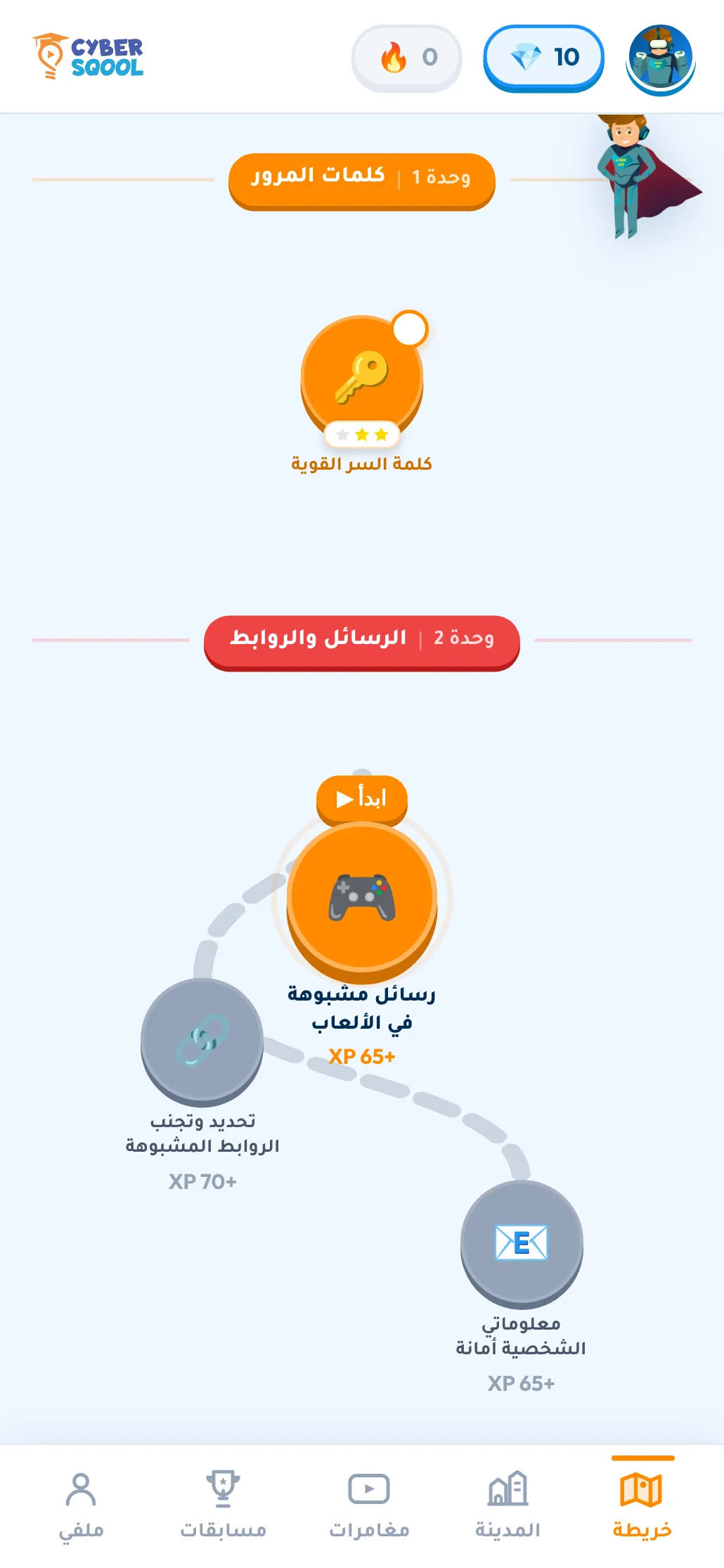
Knowing a safety rule in a quiz is not the same as using it when a suspicious message appears. Strong lesson design begins with the action a learner should be able to take, then builds practice around it.
From play to learning: design the lesson first
Play is not decoration added to a lesson, and a game does not guarantee learning by itself. It has educational value when its rules, questions and choices serve a clear goal: for example, helping a child recognize a phishing message, pause an uncomfortable chat, or ask a trusted adult for help.
A review from the U.S. Institute of Education Sciences (IES) considers teacher-directed, child-directed and mutually directed play. It also cautions that rigorous research on play's effects on achievement in the early grades remains limited. That is a reason to avoid inflated promises: design the activity, then check what children actually learned.
Start with an observable learning goal
Replace a broad goal such as “understand phishing” with an action a teacher can notice: “When a message urgently asks for a password or verification code, the learner pauses, does not follow the link, checks the sender through a separate channel, and asks a trusted adult.” A precise goal helps schools choose a relevant practice scenario and see whether a learner can apply the idea to a new example.
Manage cognitive load one step at a time
Children learn more easily when they are not processing long instructions, unfamiliar terms, a complex interface and a risky scenario all at once. Break the idea into short steps. Explain only the terms needed for the task, show one clear example, and then invite the learner to try. Visuals and sound should clarify the decision; decorative elements that compete for attention can be removed.
Use scaffolding as temporary support
A prompt such as “What is the sender asking you to do?” can help a learner notice a clue. The next step might compare the sender name with the link; a later scenario can ask the learner to make a decision without prompts. As performance improves, reduce the support gradually. Scaffolding should help a child think through a choice, not make the choice for them.
Give feedback that explains the next step
If a learner selects a suspicious link, “wrong” is not enough. Point out the missed clue, explain a safer next action, and allow another attempt. When the choice is sound, ask which clue informed it. That connects the decision to reasoning rather than luck.
Practise transfer, not just a familiar quiz
A child may succeed on a familiar question and struggle when the sender name or app changes. Vary the context gradually: a message inside a game, an invitation from an unknown account, then a request for a verification code. Revisit the idea later and ask learners to explain their reasoning in their own words. Speed, points and participation measure engagement; on their own, they do not prove that a skill transfers to everyday situations.
A school leader’s review checklist
• Does the lesson name an observable skill or behaviour?
• Do the game rules support that goal, or distract from it?
• Does practice move from a clear model to independent decisions?
• Does feedback explain why and what to do next?
• Is the language and scenario suitable for students’ ages and digital experience?
• How will teachers notice progress and adapt the next lesson?
What this means for Cyber Sqool
In a LinkedIn post, Cyber Sqool’s founder says the team draws on educational game-design and learning-science principles, and describes discussing cognitive load and scaffolding during a Mastercard Foundation EdTech Fellowship bootcamp. This reports the team’s stated experience; it does not establish a formal partnership with, or endorsement by, Carnegie Mellon University. School leaders should evaluate any program by its learning goals, practice design and classroom fit—not by brand names, promises or the presence of a game alone.
The practical test
A strong learning game gives a learner a chance to notice, decide, understand the consequence, and practise again in a different context. For school leaders, the key question is not only “Do students enjoy it?” but also “What can they do afterwards, and how will we know?”
Sources
• U.S. Institute of Education Sciences, review of play as a teaching strategy: https://ies.ed.gov/learn/blog/play-and-learn-effectiveness-play-teaching-strategy-early-grades
• Carnegie Mellon University LearnLab, scaffolding and fading in course design: https://learnlab.org/certificate/courses/scaffolding-and-fading-in-course-design/
• Cyber Sqool founder’s LinkedIn post on educational game design and learning science: https://www.linkedin.com/posts/badreddin23_edtech-scienceoflearning-cybersafety-activity-7476950339158568960-p0YY